
Updated October 23, 2026
A professional GPS tracker is a self-contained device fixed to a company asset (container, skip, trailer, cart, tooling) that calculates its position by satellite and sends it over a cellular network to a tracking platform. Unlike a consumer tracker, it is designed to run for several years on a single battery, withstand shocks, water and extreme temperatures, and be managed by the hundreds or thousands from the same software.
We design industrial GPS trackers, in two models (Europe and worldwide), and the platform that uses their data. This page explains how to choose a GPS tracker for industrial and logistics assets, what really drives its battery life, and how to follow the same object outdoors and inside your buildings.

Trackers sold for cars, bikes or pets are recharged every week or every month and managed one by one in an app. On a fleet of 500 containers or 200 skips, that model does not work: nobody recharges 500 devices. The criteria for a professional GPS tracker are therefore different.
| Criterion | Consumer tracker | Professional GPS tracker |
|---|---|---|
| Battery life | A few days to a few months, rechargeable battery | Several years on a battery, no recharging |
| Ruggedness | Household use | IP68 waterproof, shock resistant (IK), −40 to +85 °C |
| Network | 2G/4G, often a single country | Low-power LTE-M / NB-IoT, built-in SIM, multi-country roaming |
| Management | One app per tracker | One platform for the whole fleet: zones, alerts, history, export |
| Integration | None | API to your ERP, WMS or CMMS |
| Inside buildings | Position lost or inaccurate | Bluetooth (BLE) relay with fixed anchors |
Both models share the same housing and battery. The Europe model targets maximum battery life in Europe; the worldwide model adds global coverage, more satellite constellations and options for air transport.
| Feature | Europe model | Worldwide model |
|---|---|---|
| Battery life | Up to 8 years at 1 position per day; 6 years at 2; 4 years at 4 | Up to 6 years at 1 position per day; 3 years at 4 |
| Battery | 7,000 mAh lithium (LiSOCl2), 3.6 V, replaceable | |
| Satellites | GPS, QZSS | GPS, Galileo, GLONASS, BeiDou, QZSS |
| Cellular network | LTE-M, NB-IoT | LTE-M, NB-IoT, LTE Cat 1bis, 2G fallback |
| Coverage | Europe, built-in SIM | More than 190 countries, built-in SIM |
| Bluetooth Low Energy | BLE scanning, zone and anchor detection | BLE scanning, anchor mode, remote updates over BLE or cellular |
| Sensors | 3-axis accelerometer (movement, shocks); optional temperature, humidity, pressure | |
| Fallback position | Cell-tower location when GPS has no fix | |
| Housing | 104 × 52 × 35 mm, 130 g, polycarbonate, IP68, IK07, −40 to +85 °C | |
| Specific features | Power-saving mode with indoor detection | DO-160 certification, AES-256 encryption, automatic take-off detection (flight mode) |
| Datasheet | Datasheet (PDF) | Datasheet (PDF) |
Both trackers are CE and RoHS certified. The choice depends mainly on geography: assets that stay in Europe → Europe model; assets that travel outside Europe or by air → worldwide model.
The advertised battery life depends first on the number of positions per day: going from one to four daily positions halves the battery life of the Europe model (8 years → 4 years). But in the field, another factor weighs just as much: failed GPS searches.
When a tracker is parked under a metal shelter or in a hangar, it searches for satellites without finding them. On a fleet we analyzed, one failed search used as much energy as about a hundred successful positions (240 seconds of GPS on, against a median of 2 seconds for a successful fix), and the trackers that failed most lasted half as long as the others. Three settings fix this problem:
That is why we configure each deployment to the real rhythm of the assets, not with a single position frequency.
GPS needs to see the sky. In a warehouse, a workshop or a storage hall, it is off by tens of meters or stops responding. Our trackers therefore combine two technologies:
The same container can be followed on the road between two plants, then in the workshop where it is emptied. To understand how Bluetooth Low Energy works, see our guide to Bluetooth Low Energy (BLE).
Bins, racks, pallet boxes and carts circulate between suppliers, plants and customers, and some are lost at every rotation. A GPS tracker on each container gives its current site, idle time and trip history. One manufacturer tracks 3,000 containers across several sites from a single map.
In waste management, skips are dropped at customer sites and then forgotten. The tracker shows where each skip is and for how long, so rental can be billed to the day and collections planned.
Between two production sites, the platform rebuilds the full journey of each piece of equipment and measures the minimum, average and maximum transit time of each step. Bottlenecks and blocked shipments become visible without manual records.
Ground carts, containers and equipment shipped in the hold: the worldwide model detects take-off, switches off GPS and radio during the flight, then reactivates them on landing, in line with air transport requirements. See our page on the GPS tracker for aviation assets (RTCA DO-160G).
Tracking bins, racks or containers between your plants and suppliers? See our page on reusable container tracking.
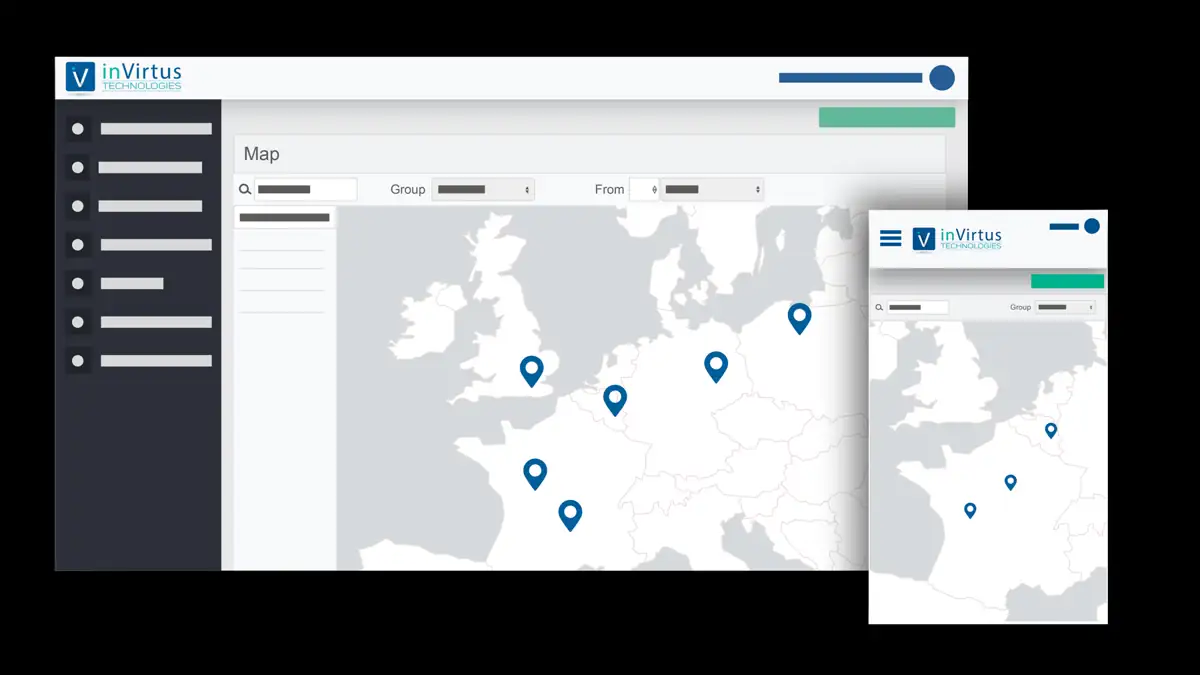
It is a self-contained device that calculates its position by satellite and sends it over a cellular network to a platform. It differs from a consumer tracker by a battery life of several years, a waterproof and shock-resistant housing, and centralized fleet management.
To follow an object remotely, the tracker must transmit its position, so it uses a network. That connectivity cost always exists, whether billed separately or included. On our trackers, the SIM card is built in and connectivity is included in the annual platform license: there is no carrier contract to manage.
It depends on the number of positions per day and on reception conditions. The Europe model lasts up to 8 years at one position per day and 4 years at four; the worldwide model up to 6 years at one position per day. The battery is replaceable.
Poorly: satellite signals barely pass through roofs and metal structures. Our trackers then use Bluetooth Low Energy to locate themselves with fixed anchors, and cell-tower positioning as a last resort.
The tracker keeps taking positions and stores them in memory, then sends them as soon as it is back in coverage. The trip history remains complete.
Tracking a company asset (container, skip, tooling) is the simplest case. If the asset is used by an employee, for example a vehicle, tracking must comply with data-protection rules such as the GDPR: a stated purpose, information to employees and a limited retention period.
Tell us which assets you want to track, how many and where they move: we will propose the tracker, the position rhythm and the matching battery life. Contact us.

