
Updated October 21, 2026 · InVirtus Technologies, Nantes, France
A Bluetooth beacon is a small tag that broadcasts its identifier over Bluetooth Low Energy (BLE) at regular intervals, so that a receiver knows it is nearby. Attached to a tool, a cart, a medical device or a vehicle, it tells you which zone the asset is in, without scanning it by hand.
A beacon on its own does nothing: you need receivers that hear it and a platform that turns those detections into positions, inventories and alerts. InVirtus designs all three in Nantes, France: ivBeacon tags, ivScan gateways and the InVirtus Cloud platform.
What sets our BLE beacons apart
Six models cover industrial use cases, from small tools to vehicles: choose based on the size of the asset, the available light and the environment.
| Model | Size and weight | Power and battery life | Range (open space) | Protection and temperature | Sensors and options | Best for |
|---|---|---|---|---|---|---|
 ivBeacon EosFlex | 70×40×2 mm or 50×40×2 mm, under 1 g | Battery-free, organic solar cell from 30 lux; optional 2 mAh buffer battery | 50 m (165 ft) at 0 dBm | IP65, −20 to +60 °C | Temperature, light, accelerometer; optional NFC and AoA | Tooling, boxes, work in progress, flat objects |
 ivBeacon Lite | Ø 44 mm, 13 g | Replaceable CR2477 1,000 mAh coin cell, 5 years (one transmission every 4 s) | up to 120 m (400 ft) | Polycarbonate housing | LED and buzzer triggered from a smartphone | Vehicles, carts, fixed reference points in buildings |
 ivBeacon Micro | 36×26×6 mm, 7 g | 220 mAh battery, 5 years | 70 m (230 ft) at 0 dBm | IP68 (1 m for 5 h), −20 to +60 °C | Temperature, Hall-effect switch | Medical devices, measuring instruments |
 ivBeacon Wristband | 36.2×26.1×7.5 mm, 9.5 g | 220 mAh coin cell; about 8 months at one transmission every 0.9 s (factory setting), longer with a wider interval | 50 m (165 ft) | IP66, −20 to +60 °C | Wristband | People: patients, operators |
 ivBeacon Display | 3 screen sizes (2.1", 2.9" and 4.2"), from 74×40×12 mm to 103×92×8 mm; 37 g for the 2.1" | 2 × CR2450 coin cells, 3 to 5 years at 3 screen updates per day | 30 m (100 ft) | 0 to +50 °C | E-ink screen showing business data | Containers and bins whose status must be readable on site |
 ivBeacon Hybrid Available early 2027 | 62×39×10.5 mm, 4 g | Replaceable CR2032 coin cell (240 mAh): up to 3 years at one advertisement every 5 s | BLE up to 200 m (650 ft) at +8 dBm; UHF RFID up to 4 m (13 ft) | IP67, IK07, −40 to +85 °C (extended version) | BLE 6.0 (AoA, Channel Sounding), 868 MHz UHF RFID, NFC, satellite connectivity, temperature and humidity (±0.1 °C), accelerometer, gyroscope | Assets tracked over both BLE and RFID; the ideal companion to the ivScan Hydra |
Coming in early 2027: the ivBeacon Hybrid combines BLE 6.0 (angle of arrival and Channel Sounding), UHF RFID and NFC in a single 4 g tag. It is the ideal companion to the ivScan Hydra for mixing BLE (AoA) positioning and RFID reading on the same site.
All our beacons transmit in InVirtus, iBeacon and Eddystone formats (EosFlex: InVirtus and iBeacon per the RevC datasheet).
The choice of receiver depends on two questions: is there power and network where you need to listen, and do you need a real-time position or presence by zone?
| Receiver | Power | Network | Capacity | Best for |
|---|---|---|---|---|
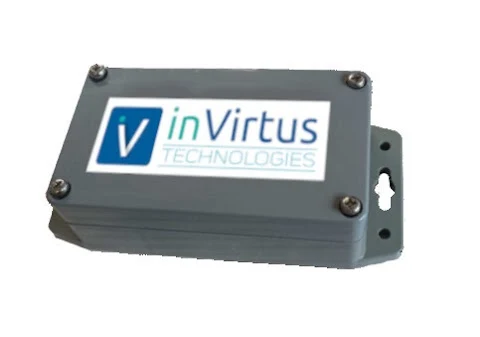 ivScan Poseidon | ER18505 16,000 mAh battery (32,000 mAh for Poseidon+), IP67, −40 to +80 °C | LoRaWAN | Battery life: 60 months for 50 beacons scanned every 30 min, 2 months for 25 beacons scanned every minute | Areas without power or network: yards, depots, existing buildings |
 ivScan Chronos | 5 V mains, micro-USB or PoE | Ethernet, Wi-Fi | Real-time reading | Equipped workshops and warehouses, continuous tracking |
 ivScan Hydra | PoE (IEEE 802.3af) or 5 V DC, −25 to +65 °C | Ethernet, Wi-Fi | BLE and UHF RFID in one reader: 250 BLE beacons/s, 900 RFID tags/s, up to 6 antennas | Sites that mix beacons and RFID tags |
| Smartphone (Android, iOS) | Phone battery | 4G, Wi-Fi | Proximity reading, search radar | Finding an asset, patrols, lone workers |
For centimeter-level positioning, angle-of-arrival (AoA) anchors locate beacons to within 30 cm (1 ft).
Beacon detections flow into InVirtus Cloud, which places them on your building floor plans and on a map for outdoor areas.
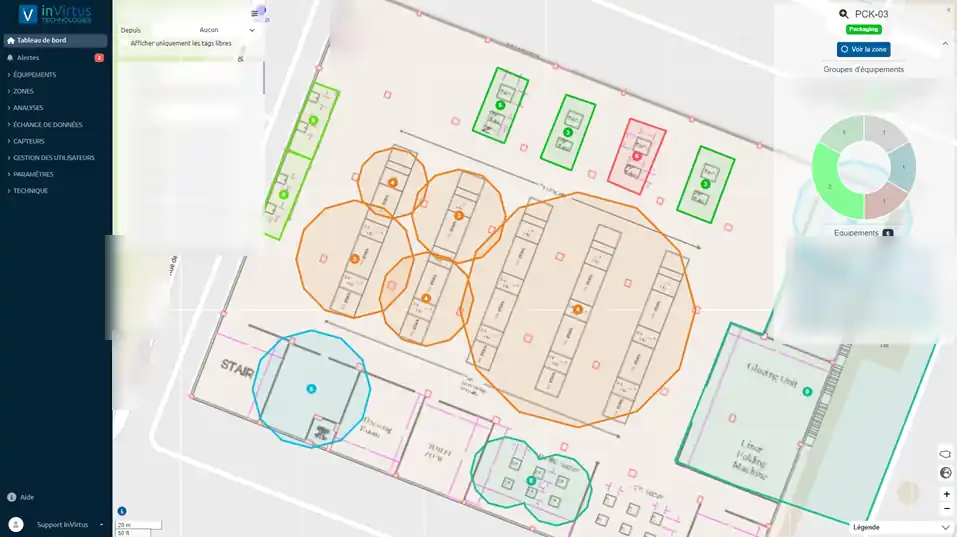
Floor plan view: each circle or rectangle is a zone covered by a receiver, and the number shows how many assets are in it. Click a zone to open its inventory.
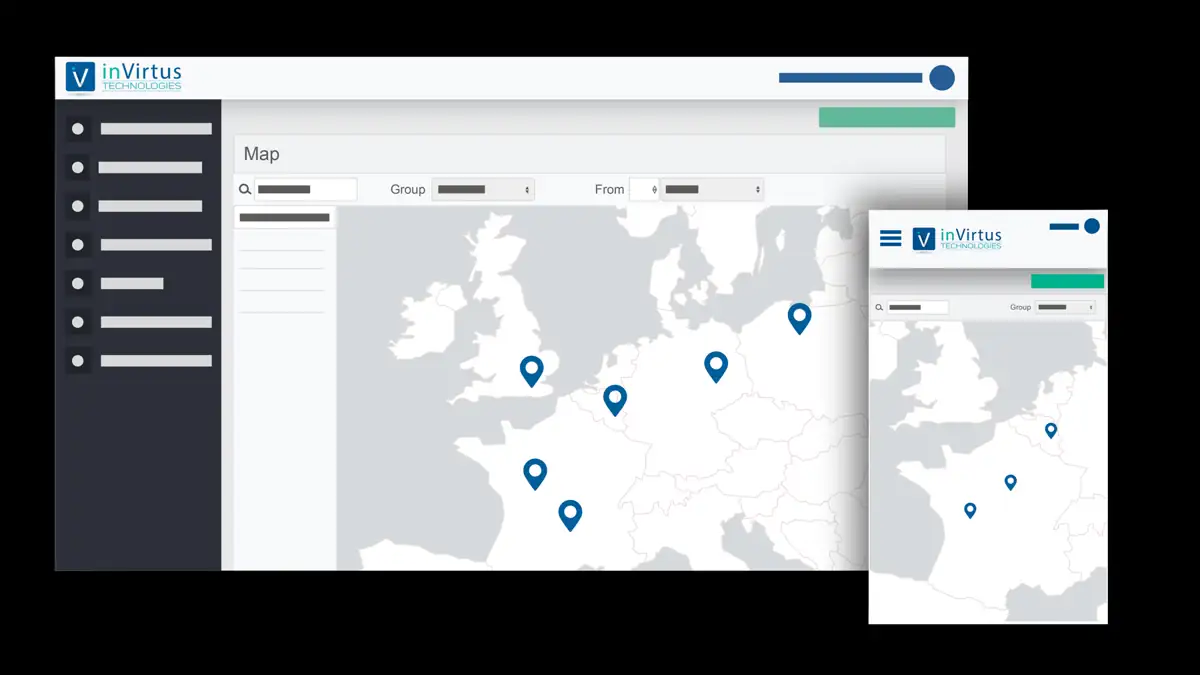
Map view, on desktop and mobile: the same assets tracked across several sites.
A major urban transit operator automatically locates its buses, where a driver used to check parking spots on foot for 7.5 hours every evening, and logs every pass through the washing station. The pilot ran for 8 months in a depot of 74 vehicles; only one anchor and one beacon were damaged over the period.
| Before | With InVirtus | |
|---|---|---|
| Evening bus parking | A driver assigned to the yard checks on foot, from 5:30 pm to 1 am, that each bus is in its spot | Each bus position is shown in real time; the yard supervisor validates from a tablet |
| First departures | Drivers search for their bus across a large yard, at the risk of delaying departure and incurring penalties from the transit authority | A screen at the dispatch office shows where each bus is before the shift starts |
| Breakdowns at startup | Maintenance staff lose time finding the faulty bus | The bus is found in the mobile app, with a buzzer |
| Washing (every other day per bus) | No record of passes | History per bus, alert if a bus has not been washed for a configurable number of days, information sent to the line manager |
| Pilot fact sheet | |
|---|---|
| Network | 130 bus lines, 1,088 vehicles, 9 maintenance workshops |
| Scope | 1 depot, 74 vehicles parked on 2 levels |
| Beacons | 1 ivBeacon Lite under each chassis, range set to 1 m (3 ft), 5-year battery life at one transmission every 4 s |
| Anchors | Waterproof ivScan Poseidon units in floor domes at each washing station, 1 m (3 ft) range, 5-year battery life at one scan every 30 min |
| Network | 1 private 4G/LoRa gateway, 200 m (650 ft) radius in open space |
| Software | InVirtus platform (monitoring, alerts, exports, public APIs) and Android search app |
| Reliability | 1 anchor and 1 beacon damaged in 8 months |
| Adjustments | 10 to 30 min lag between field and screen fixed by synchronizing anchor scan start times; wired anchor planned at washing stations for continuous scanning; anchor dome redesigned as a single piece |
What the customer valued over the other solution considered: the most attractive price, a floor anchor that was already waterproof, and the most responsive team to run the pilot. In its review, it highlights the robustness of the hardware, project follow-up every two weeks and a "very visual" platform.
A beacon project almost always starts with a pilot of a few weeks to 3 months on one zone, before rolling out to the whole site.
The cost has three parts: hardware (beacons and receivers, with volume-based pricing), the platform subscription (based on the number of tracked assets) and installation. Hardware leasing is available. A single beacon costs little; it is the number of receivers, set by the required accuracy, that drives the budget.
A BLE beacon is a radio transmitter that repeats its identifier at regular intervals over Bluetooth Low Energy. A gateway or a smartphone can read it without pairing.
iBeacon (Apple) transmits a fixed three-part identifier. Eddystone (Google) can transmit an identifier, a URL or telemetry data. Our beacons and gateways support both, in addition to the InVirtus format.
One beacon per asset to track, and one receiver per zone to distinguish. A zone can be a room, a storage aisle or a washing station: the required accuracy sets how many you need.
Yes. Outdoors, our battery-powered receivers send detections over LoRa or 4G, with no wired network. To track an asset between two sites, you add a GPS tracker.
About every 5 years depending on the model and transmission interval, and never for the EosFlex, which recharges from light. On models that measure it, such as the ivBeacon Micro, battery voltage is reported to the platform.
Yes. Our gateways read iBeacon, Eddystone and the formats of several other manufacturers, so you can keep an existing fleet.
Run a pilot sized on your floor plans, with KPIs set from day one. Request a pilot
Learn more: Understanding Bluetooth Low Energy

