
Tracking medical equipment in hospitals
Updated 15 November 2026 · InVirtus Technologies, Nantes, France
To track mobile medical equipment in a hospital (syringe pumps, infusion pumps, beds, wheelchairs, carts, ultrasound scanners), you attach a Bluetooth tag to each device and install anchors in the wards. The platform then shows the ward and room where each device is, and sends an alert when it leaves its zone. InVirtus Technologies designs these tags, anchors and the InVirtus Cloud platform in Nantes, France.
In short
- How: a Bluetooth (BLE) tag on each device, anchors in the wards, and a platform that shows the ward and room.
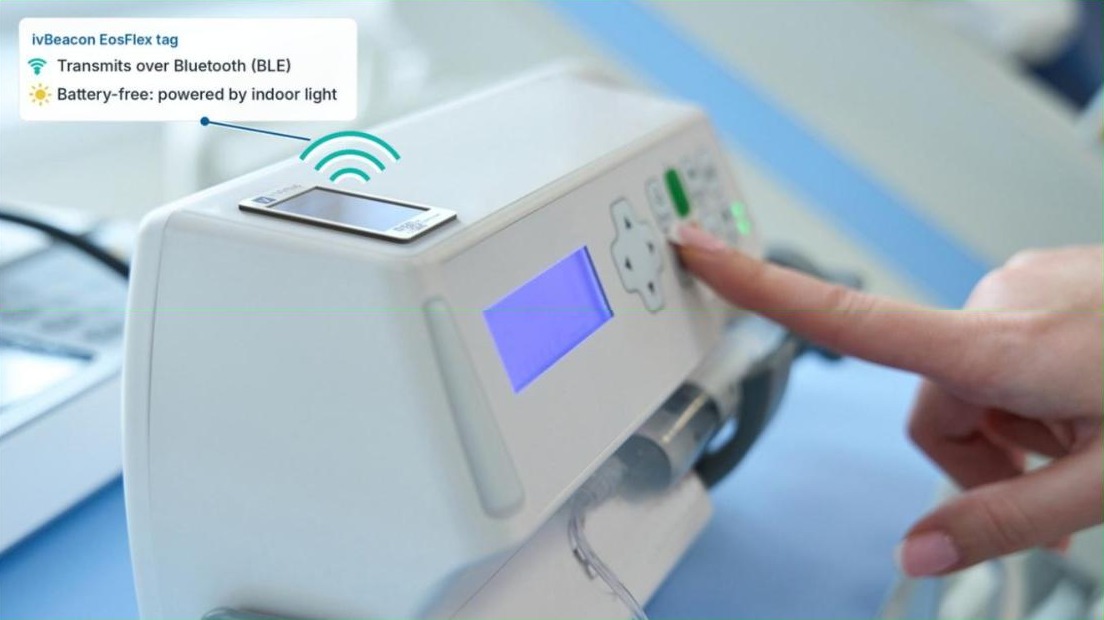
- Battery-free: the ivBeacon EosFlex tag runs on indoor light, from 30 lux. No battery to replace.
- No building work: ivScan Poseidon anchors run on batteries, with no cabling in the wards.
- Health data: the platform can be hosted in France on HDS-certified infrastructure (Scaleway).
- Getting started: a pilot in one ward, from a few weeks to 3 months.
What you know about each device
- Where it is: building, floor, ward and room, on a floor plan of the site.
- Since when: movement history and time spent in each ward.
- When it leaves its zone: an alert when a device leaves a ward, a floor or the site.
- Whether it is available: a view of devices in storage, in use or in maintenance.
- When to service it: usage time to plan preventive maintenance and find the device due for service.
Which technology to choose in a hospital
| Technology | What it gives you | When to choose it |
|---|---|---|
| Bluetooth (BLE) with anchors | Ward and room-level position (1 to 5 m), continuous, zone alerts | Permanent tracking of mobile equipment; the most common case |
| Passive UHF RFID | Detection when passing a portal or a handheld reader | Inventories, stock or sterilisation entries and exits |
| Wi-Fi | Position from existing Wi-Fi access points, variable accuracy | When Wi-Fi covers every ward well |
| UWB | Position to within one metre | Very fine accuracy, with denser infrastructure |
| GPS and cellular | Position outside the hospital | Equipment lent for home care, devices shared between sites |
In most hospitals, Bluetooth is enough indoors; a GPS tracker is added to equipment that leaves the site.
The InVirtus solution for medical equipment
ivBeacon Bluetooth tags
| Tag | Power | For which equipment |
|---|---|---|
| ivBeacon EosFlex | Light, battery-free, from 30 lux; 2 mm thick, IP67 | Beds, wheelchairs, carts, syringe pumps: no battery to replace |
| ivBeacon Lite | Battery, 5-year life; IP67, LED and buzzer | Equipment stored in dark rooms |
| ivBeacon Micro | Battery, up to 8 years; 36×26 mm, IP68, temperature sensor | Small devices: pumps, monitors |
| ivBeacon Display | 2 batteries, over 4 years; e-paper screen updated remotely | Show the device status on the device: clean, due for service, reserved |
ivScan anchors
The ivScan Poseidon runs on batteries (5 years) and transmits over LoRaWAN: it installs without cabling, so no building work in the wards. The ivScan Hydra reads both Bluetooth tags and passive UHF RFID labels. It is powered and connected to the network through a single PoE cable, or simply plugged into a socket with a cellular dongle, with no change to the hospital's IT network. It handles up to 250 reads per second and takes 1 to 4 RFID antennas.
Why add RFID to Bluetooth
Bluetooth gives the continuous position of valuable equipment. UHF RFID completes it for numerous or low-cost items: a passive label costs far less than a Bluetooth tag, has no battery and is read when it passes a door or an airlock. With the same ivScan Hydra anchor, the hospital tracks its equipment over Bluetooth and checks the entries and exits of RFID-labelled items (small equipment, kits, linen), with no second infrastructure.
The InVirtus Cloud platform
Floor plans of the site, search for a device by name or type, zone alerts, history, an API for your CMMS, single sign-on (SSO), cloud or on-premises hosting. The mobile app lets staff find a device from the ward.
Health data hosting (HDS)
In France, personal health data must be entrusted to a host certified HDS (Hébergeur de Données de Santé, health data host), as required by article L.1111-8 of the French Public Health Code. HDS certification is issued by an accredited certification body; it guarantees a level of security, confidentiality and availability suited to this data. It becomes necessary as soon as the solution processes health data, for example when it also tracks patients.
The InVirtus Cloud platform meets this requirement: InVirtus has signed an HDS services contract with Scaleway, an HDS-certified French cloud provider. The platform can therefore be hosted in France on HDS-certified infrastructure to protect the hospital's data.
Use cases
| Equipment | What tracking changes |
|---|---|
| Syringe and infusion pumps | Nurses see where the nearest available device is instead of searching every ward. |
| Beds and wheelchairs | Porters and logistics see available stock on each floor. |
| Biomedical equipment due for service | The biomedical team finds the device on its preventive maintenance date. |
| Equipment lent for home care | An ivTrack GPS tracker follows the device outside the hospital and reports its return. |
Use case: tracking emergency department stretchers
In the emergency department, a stretcher goes with the patient to the inpatient wards, sometimes to the top floor, and does not always come back. The fleet runs down and nobody knows where the missing stretchers are. Rather than equipping every floor, one anchor at each lift exit of the receiving wards is enough to know the last floor the stretcher went to.
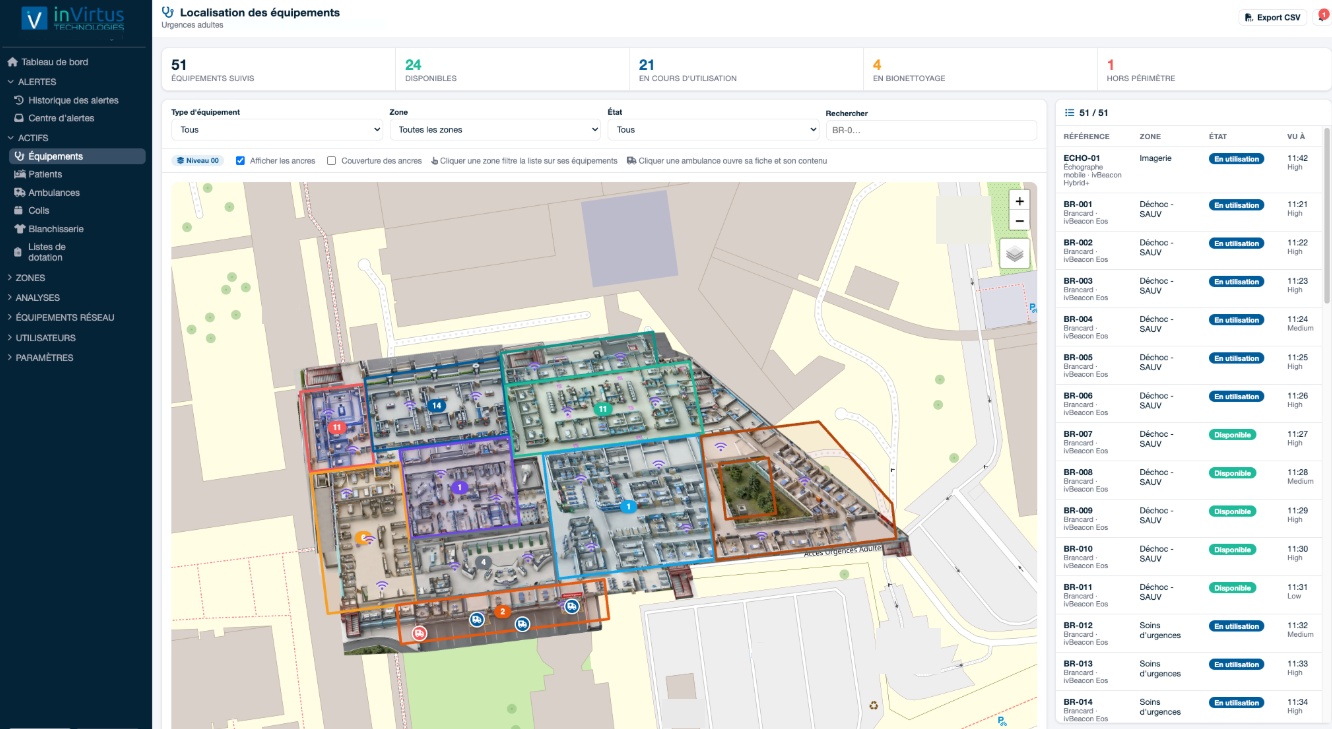
- Emergency department: full coverage: anchors spread across each area (reception, imaging…) locate the stretcher by zone, in real time.
- Receiving wards: one anchor per landing: each lift exit of the priority wards is equipped: you know which floor the stretcher went to.
- Return alerts: stretcher out of the emergency department for more than X hours, or minimum stock not reached: the team is notified.
- Scalable without starting over: floors can later be fully covered, with the same anchors and the same platform.
To measure the benefit, the whole stretcher fleet must be tagged: tagging one in five would not show where they pile up.
Download the stretcher use case (PDF, in French)
The 10-page document details emergency department coverage, anchor placement, alerts and deployment. Enter your details: the download link appears as soon as the form is sent.
How a deployment works
- Inventory and floor plans: list of devices to track and plans of the wards involved.
- Pilot in one ward: from a few weeks to 3 months, to measure accuracy, battery life and staff adoption.
- Installing tags and anchors: no cabling with battery-powered anchors.
- Connecting to your software: CMMS or other tool, via API.
- Roll-out to other wards and sites.
What to check in your specification
- Tag compatibility with your cleaning and disinfection products, and protection rating (IP67 minimum).
- Real battery life of tags and anchors, and who replaces batteries.
- Expected accuracy: ward, room or under one metre.
- Integration with the CMMS and other software, API documentation.
- Data hosting: HDS certification of the host, single sign-on, access rights.
- GDPR assessment if the solution also tracks people (patients or staff).
Learn more: our healthcare solutions, the RTLS guide, Bluetooth Low Energy, lone worker protection.
Request a study or a pilot in one ward
Frequently asked questions about medical equipment tracking
Which medical devices can be tracked?
Any mobile device a tag can be attached to: syringe pumps, infusion pumps, beds, wheelchairs, stretchers, carts, ultrasound scanners, monitors, ventilators, equipment lent for home care.
How do you track stretchers that leave the emergency department?
Each stretcher gets a Bluetooth tag and the emergency department is fully covered with anchors. On the floors, one anchor at each lift exit of the receiving wards is enough to know which floor the stretcher went to, and an alert warns the team when it has not come back after a few hours.
Does the tag need a battery?
Not the ivBeacon EosFlex: it is powered by the building's indoor light, from 30 lux, and transmits over Bluetooth (BLE). There is no battery to replace or recharge.
Do the wards need cabling for the anchors?
Not necessarily. The ivScan Poseidon anchor runs on batteries and sends its data over LoRaWAN, without cabling. The ivScan Hydra connects over PoE, or to a simple socket with a cellular dongle, with no change to the hospital network.
What accuracy can be expected in a hospital building?
With Bluetooth tags and anchors, a device is located at ward and room level, about 1 to 5 m. Sub-metre accuracy requires UWB, which is more costly to install.
Do the tags withstand cleaning?
The ivBeacon EosFlex, Lite and Display tags are IP67. Have their compatibility with your cleaning products validated during the pilot.
Can tracking be connected to our CMMS?
Yes. The InVirtus Cloud platform has an API: each device's position and history can be shown in the CMMS or other hospital software.
Is the platform HDS-compliant?
Yes. InVirtus has signed an HDS services contract with Scaleway, an HDS-certified (health data host) French cloud provider. InVirtus Cloud can be hosted on this infrastructure, or on the hospital's own servers.
Who offers this type of solution?
Several suppliers exist. InVirtus Technologies, based in Nantes, France, designs Bluetooth tags (including battery-free tags), anchors and the platform, and starts every project with a pilot in one ward.

